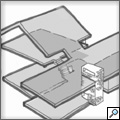
Fig1. House Layout |
Layout
The house is designed in a "T" shape where the top
of the T contains the spaces that you would normally occupy
during the day - the living room, dining room, kitchen and
powder room. This part of the house is at ground level and
faces the street in front of the house.
The back part of the T is split into two levels and contains
the spaces that you would use at night - the bedrooms, master
bath and dressing room, the playroom/office and utility rooms.
Because the back part of the T does not have any cathedral
ceilings the spaces are more intimate and cozy and the physical
separation of the space means that if you are in the bedroom
you are not disturbed by any noise in the main part of the
house and vice versa.
Although it's not a large physical separation the psychological
effect is one of a much bigger house. |
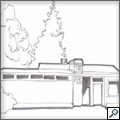
Fig2. Facade |
Street Presentation
Because of the way that the house is positioned on the site,
the front of the house presents itself as a small bungalow
that belies it's actual size, which is in keeping with the
rest of the houses on the street. The rear of the house where
the night areas are are hidden from view from the front in
part helped by the gentle slope of the roof of the front part
of the house.
As a result the house seems to sit comfortably on the visible
part of the property and at the same time makes the surrounding
property seem larger as well. |
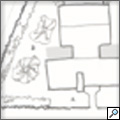
Fig3. Site Plan |
Siting
The house is sited on a triangular-shaped lot that has a change
of grade from the front to the apex of the triangle. The way
that the house is situated allows for a number of design features:
1) the lower level at the back of the house is about 50%
above grade which allows for full sized windows to be used
all around. This makes the lower level incredibly light and
airy
2) the house is presented to the street with the least amount
of traffic making access much easier, and allowing for the
kitchen and window above the sink to face the street, making
it much easier to see and interact with neighbours and friends
walking by and
3) the house divides the odd shaped lot into 4 distinct outside
areas A) the front lawn B) the side yard C) kitchen yard and
D) the back yard. Both the kitchen and side yard have patios
directly accessible from the kitchen and living room. |
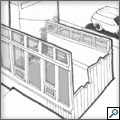
Fig4. Window Layout |
Windows
One of the most noticable things about the Trend House is
the amount of windows it uses. In addition to having a large
number of windows (almost 80) it also makes use of the glass
to focus the views onto the privacy of the yards.
For example in the living room the large windows face the
back yard instead of the street which makes it much less necessary
to cover the windows for privacy. The clerestory windows on
the side of the house facing the street let the light in during
the day and provide a soft light on the facade at night. It
also makes it possible to see the beamed, cedar planked ceiling
from the outside.
Similarly in the kitchen large windows face onto the back
yard while the smaller windows face onto the street. The smaller
window over the sink allows you to keep tabs on what's happening
in the neighbourhood but the focus of the room is on the view
of the windows facing the garden. |
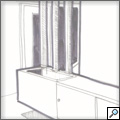
Fig5. Built-ins |
Built-Ins
A big feature of mid-century modern design is the use of built-in
furniture and storage, and the Trend House is no exception.
The most visible of these is in the dining room in the form
of a sideboard. It has a zinc lined planter built into it
and is mirrored overhead by a valence that runs the length
of the room and has overhead lighting embedded in it.
Another example is in the dressing room where built in closets
and dressing tables have been custom created for the house.
Some of the original illustrations of the rooms as dressed
by Eaton's shows similiar design details in things like the
bedside tables and dressers in the bedrooms. |
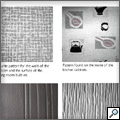
Fig6. Interior finishes |
Finishes
The Trend Houses featured a number of interesting wall finished
in wood, plywood and laminate materials. A lot of the walls
have been painted over but fortunately the roof and some of
the walls in the main floor still have their original finish.
An interesting thing we found when looking at the house more
closely was that both of the bathrooms had walls that were finished
with laminate, not something you see very often. Metal strips
were used to cover the seams, and the overall effect was not
dissimiliar to an airplane or train bathroom.
One of the most unusual features of the interior is the variety
of plywood panels used for the walls and in the kitchen ceiling.
In the dining room the plywood has been treated in such a manner
that it is pockmarked as if it had been acid etched. In the
kitchen, the walls have vertical lines pressed into the plywood
at irregular intervals, and the ceiling panels are grooved in
a square pattern. |
